
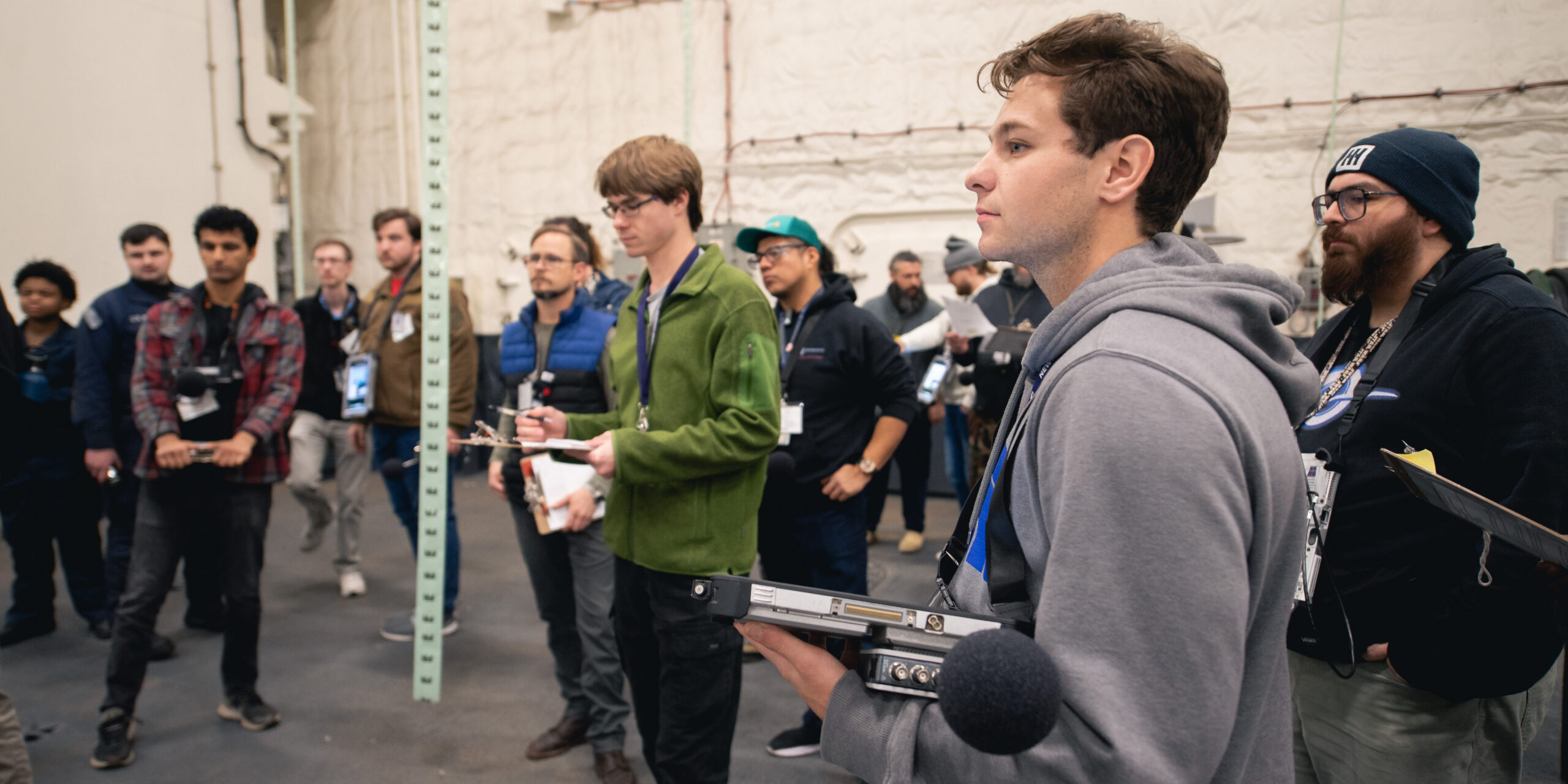
 A cross-departmental team of shipbuilders prepares to survey airborne noise levels throughout John F. Kennedy (CVN 79). Photo by Ashley Cowan
 ANTs Marching
Published February 11, 2026
Engineers from across Newport News Shipbuilding remained busy during the John F. Kennedy (CVN 79) builder’s sea trials, but the Noise and Vibration Test Engineering (NVTE) team in particular faced a daunting task: record and test noise levels in approximately 2,000 spaces of the ship using their arsenal of Airborne Noise Tablets (ANTs).
The purpose of the testing was to ensure spaces had volume levels within a safe decibel range for sailors.
Cara Johnston (E25) served as the hub of the operation. She joined NNS just six months ago after graduating from Virginia Tech. She explained that the ANTs are NNS-developed products.
“The units themselves are pieced together using tablets and advanced microphones,” she explained. “The software was developed in collaboration with the data acquisition systems (DAS) group within E25. They helped to create the display and user-friendly interface.”
Additionally, the NVTE team spent months scanning and uploading images from each survey location’s drawings. E25 included these images in the ANT software so that users knew where exactly to record their tests.
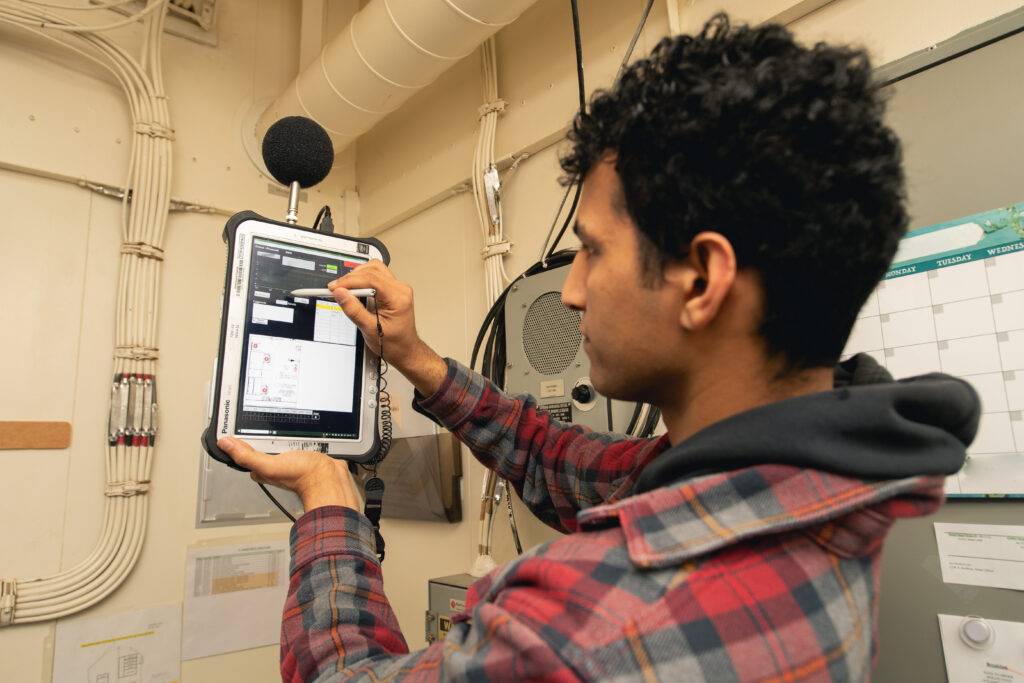
To accomplish the scope of the survey, the NVTE team relied on loaned shipbuilders from other departments. This meant the user-friendly interface was a critical component of the ANTs.
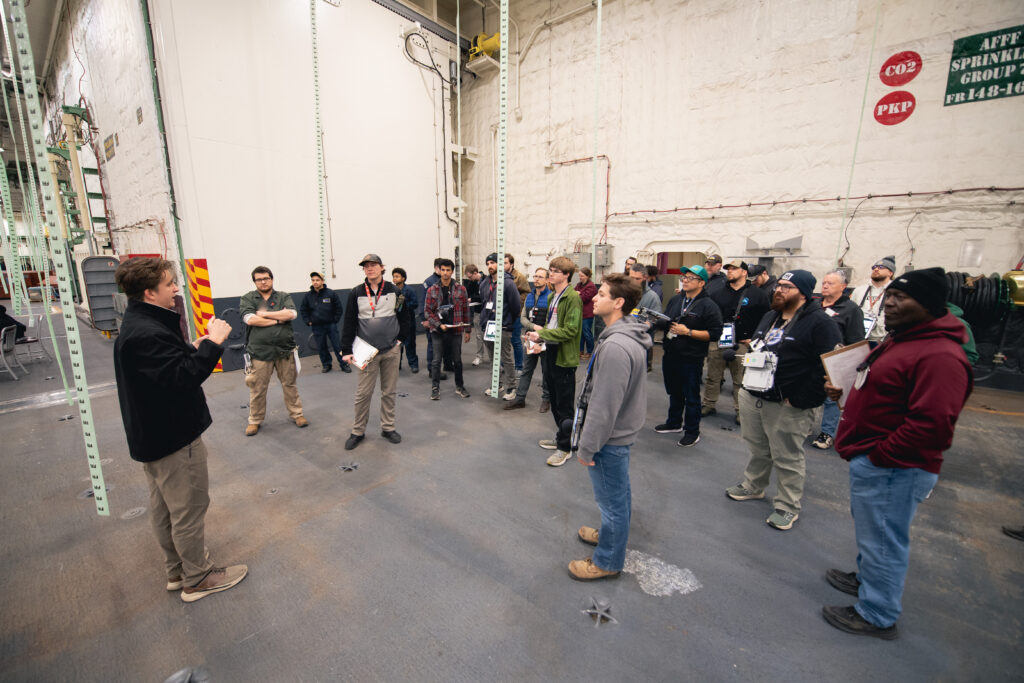
“We have 13 teams of two,” Zachary Clopton (E25) said. “Each team takes a tablet and a clipboard that has a route assigned to it. The team loads their route into their ANT, and begin collecting their data.”
One of the loaned shipbuilders, Britt Cortina (E35), typically works with SSN(X) Payload Systems.
“The team reached out to me and asked if I wanted to help with sea trials,” he said. “It was something I couldn’t turn down. This group will see the whole ship and talk to a lot of different people. Getting on board to depart was only my second time on the carrier.”
Other shipbuilders included Pat Kennedy (T53) and Herbert Fields (X75), two Master Shipbuilders who had never experienced going underway.
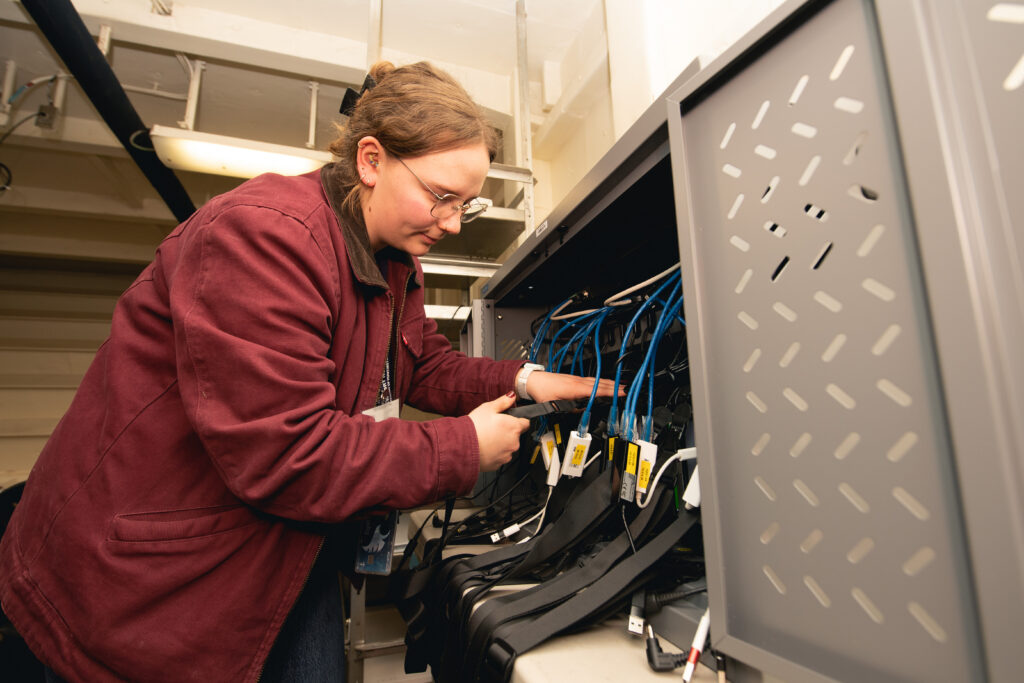
Once a team had collected data from their route, the ANT was plugged into a system called the “ANT Farm,” which uploaded the data to a master database for further analysis and tracking overall completion of the survey, and allowed NVTE to develop new routes as needed.
Not only did the team have to test levels throughout the entire ship – they also had to test again once the ship hit certain speeds.
The ANT system is a major upgrade over the commercial noise meter used during USS Gerald R. Ford (CVN 78)’s sea trials and allowed the teams to complete their routes and data collection quickly, accurately and efficiently.
“I joined the team knowing sea trials was on the horizon,” Johnston said. “It’s been a great experience – a whirlwind, but fun to experience the ship and all of the shipbuilders involved.”